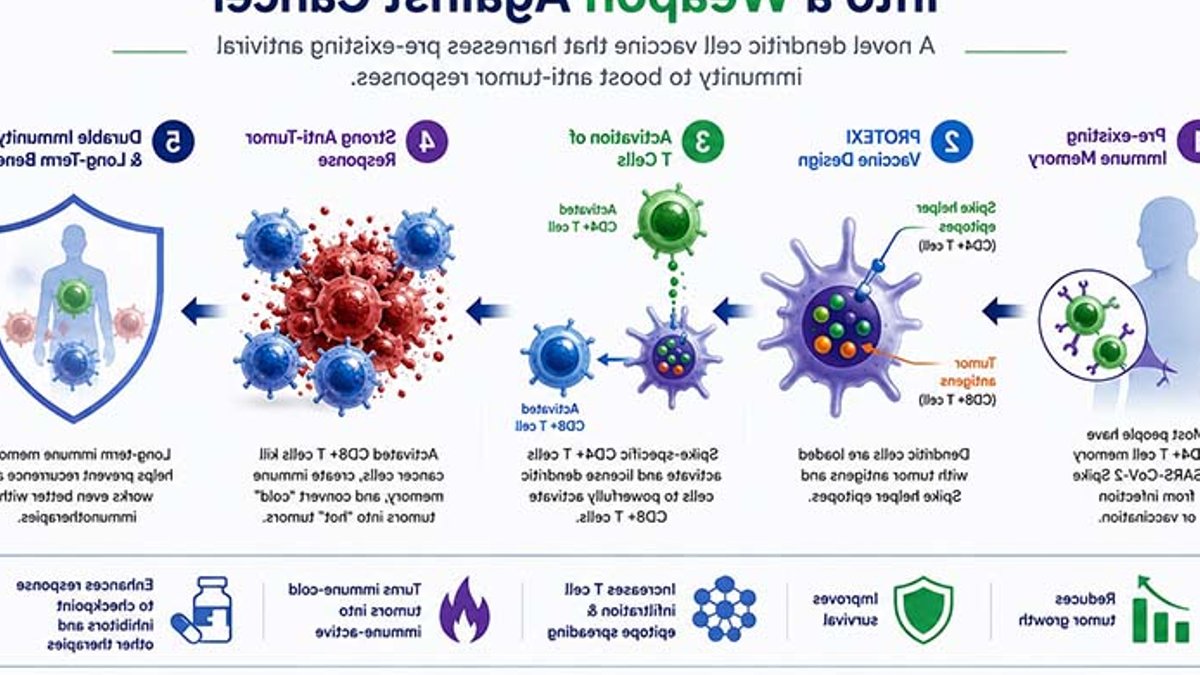
A Cleveland-based biotech, Celloram, is working on a cancer vaccine that utilizes the immune memory of COVID-19 to activate T cells against tumors in mice. The company, in partnership with Case Western Reserve University and University Hospitals Cleveland Medical Center, published preclinical results for a new dendritic cell vaccine in Nature Communications.
The vaccine, called Protexi, uses epitopes derived from the Spike protein of SARS-CoV-2 to activate CD4 T cells, in addition to CD8 cells. This approach could make the vaccine more effective than activating CD8 alone, as CD4 cells help draw CD8 cells to the tumor and give dendritic cells the signal they need to fully activate them.
How the Vaccine Works
Dendritic cell vaccines initiate and activate antigen-specific CD8 T cell responses to attack cancer cells. However, only approximately 15% of patients show an objective response. The new vaccine aims to improve this response rate by activating both CD4 and CD8 T cells.
In one experiment, mice received CD4 cells engineered to recognize the target, and Protexi showed 100% survival to day 40, compared to 40% for a conventional dendritic cell vaccine in mice. A melanoma model showed five of seven mice had tumors measuring under 200 cubic millimeters on day 26.
Utilizing COVID-19 Immune Memory
Over 80% of the U.S. population and 65% of the global population are fully vaccinated for COVID, and many who remain unvaccinated have the necessary immune memory from natural infections. This existing immune memory is the foundation for the new vaccine, as it uses the Spike protein of SARS-CoV-2 to activate CD4 T cells.
Read Also: Olanzapine Reduces Chemotherapy Nausea Symptoms
John Letterio, a co-author on the paper, stated that Spike-specific CD4⁺ T-cell memory is broadly durable across the population that’s been vaccinated or infected. Indeed, this is the premise the platform depends on. Studies have confirmed that CD4 T cell responses to COVID are durable for up to 2 to 4 years in vaccinated patients, Letterio said.
Future Development
They are now working to advance Protexi toward IND submission to the FDA and a first-in-human clinical trial in patients with sarcoma at the Angie Fowler Adolescent & Young Adult Cancer Institute. The team chose COVID because its CD4 T cell antigen has been extensively mapped, and a large proportion of the global population carries the immune memory, whether from vaccination or infection.
Letterio said any CD4 T-cell epitope that a patient already has strong, durable memory against should, in principle, be able to serve the same helper function. This mechanism could potentially work with other epitopes, making it a promising approach for cancer vaccine development.
Celloram may be able to leverage the existing immune memory of COVID-19 to create a more effective cancer vaccine as they move forward with Protexi. The global population’s immune memory of COVID-19 could potentially lead to a breakthrough in cancer treatment with this approach.
The company’s partnership with Case Western Reserve University and University Hospitals Cleveland Medical Center has been instrumental in the development of Protexi.
Read Also: 17 Proven Tips to Improve Your Health: A Comprehensive Guide to Wellness
It is worth noting that the vaccine’s effectiveness will depend on various factors, including the patient’s immune response and the type of cancer being treated.
Researchers like Letterio are working tirelessly to advance cancer vaccine development, and their efforts may lead to significant improvements in cancer treatment.
As the medical community continues to explore new approaches to cancer treatment, the development of Protexi and similar vaccines offers hope for improved patient outcomes.
The FDA’s review of Protexi will be a key step in the vaccine’s development, and the company is preparing for the submission process.
In the coming months, Celloram will likely provide updates on the progress of Protexi, including the results of clinical trials and any potential setbacks or successes.
Read Also: Introduction: Why Your Health Insurance Needs a Tune-Up
The use of COVID-19 immune memory in cancer vaccine development is a novel approach that has garnered significant attention in the medical community.
Further research is needed to fully understand the potential of Protexi and similar vaccines, but the initial results are promising.
Celloram’s work on Protexi is a sign of the power of collaboration and innovation in the pursuit of new cancer treatments.
John Letterio and his team are committed to advancing cancer vaccine development, and their work on Protexi is an important step forward.
The approach used in Protexi, leveraging the immune memory of COVID-19, is based on the idea that any CD4 T-cell epitope with durable memory can serve as a helper function, making it a versatile platform for cancer vaccine development, with potential applications beyond sarcoma.